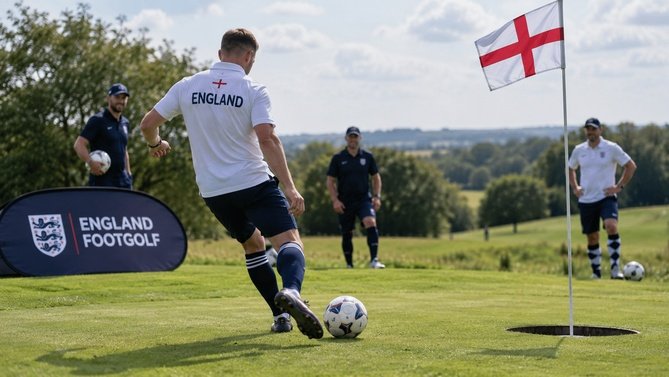
Inside England’s FootGolf Club Scene: How the Club League Is Growing the Game
FootGolf in England is not built only around national tournaments and international players. Much of the sport’s real growth happens at club level, where local players compete regularly, represent their regions and develop into national level competitors.
The FootGolf Association of England has created a structured club system that now covers four main regions: Midlands, North, South East and South West. Within those regions, clubs compete through the Club League, while players also have opportunities to move into regional and national competition.
This club structure has become one of the most important parts of English FootGolf.
Which FootGolf clubs are active in England?
The current English club scene includes a wide range of established teams from different parts of the country.
Among the clubs listed by the FootGolf Association of England are Pedham Place FGC, Gatwick FGC, London FootGolf Centre, Regent Park FGC, Ashbury FGC, Brighton FGC, Oldham FGC, Cambridge FGC, FootGolf Devon, Richings Park FGC, Uttoxeter FGC and Jurassic FGC.
That variety is important because it shows how widely the sport is spread.
The South East remains one of the strongest regions in terms of player numbers, while clubs in the North, Midlands and South West continue to provide their own local competition. The association has also stated that grassroots participation is central to future growth, with club and regional events seen as the main entry point for new players.
How the English FootGolf Club League works
The club system sits below the highest level of the English FootGolf pyramid.
Players can start with local club competition, then move into regional events and eventually onto the National Tour. This progression from club to regional to national competition is a key part of the structure used by the FootGolf Association of England.
For many players, clubs provide their first experience of regular competitive FootGolf.
That makes the Club League especially important. It gives players meaningful matches without requiring them to travel to major national events every week. At the same time, clubs create their own identity, team culture and local rivalries.
This is one of the areas where FootGolf begins to look more like a traditional team sport rather than only an individual tournament game.
The National Tour Club Cup
Club competition is also connected to the English National Tour.
Alongside individual categories, the National Tour includes the National Tour Club Cup, where players represent their local clubs and compete for the national club title. The aim is not only to reward individual results but also to create a stronger sense of club identity across the season.
This makes every strong individual performance more meaningful.
A player may be competing for their own ranking position, but their result can also contribute to their club’s progress.
That gives club members another reason to follow National Tour events and creates an additional layer of competition.
A new competition in 2026
The club scene became even more interesting in 2026 with the introduction of the Invitational Club Trophy.
The new event was created for the Regional Division Winners from the 2025 season and was scheduled for 5 September, one day before the Club League Finals.
The format is different from a normal stroke play tournament.
Each club can name up to 13 players, with eight selected for each match. Individual and pairs matchplay are combined, and every result contributes to the overall team score.
This type of competition adds another dimension to English FootGolf.
Players are no longer thinking only about their own card. They also have to manage matchplay situations, partnerships and team strategy.
That can create a very different type of pressure from normal ranking tournaments.
Why the club system matters
The importance of clubs goes beyond competition.
The FootGolf Association of England has described clubs as the backbone of the organisation and has made club development one of its priorities. In 2025, £12,000 was returned to FootGolf courses through club matches, showing that the league also provides direct financial value to venues.
This is particularly important for a growing sport.
FootGolf needs strong courses, regular players and sustainable local competitions. If clubs can bring more people onto courses throughout the year, that helps both the sport and the venues that host it.
It also creates a more stable player pathway.
A new player can join a local club, learn the competitive side of FootGolf, play regional events and eventually test themselves on the National Tour.
From club player to England selection
The pathway does not necessarily stop at national competition.
The English National Tour is now linked to future national team selection. Strong performances during the 2026 season can help players move towards England squads for events including the Development Cup, Brainstrust Cup and FIFG European Championships in 2027.
This is another reason the club system matters.
Many international players do not appear from nowhere. They begin by playing locally, develop through regional competition and then prove themselves at national level.
England’s club network provides that foundation.
The next stage for English FootGolf clubs
The main challenge now is growth.
The FootGolf Association of England has acknowledged that some areas still need more players and stronger participation. It is working on club development, national marketing and closer relationships with FootGolf venues. The association has also said that future growth must be sustainable rather than simply increasing numbers without a stable structure behind them.
That approach makes sense.
A strong FootGolf scene needs more than major tournaments. It needs active local clubs, regular matches, reliable courses and players who feel connected to a team.
England already has the foundations.
The next question is how quickly those clubs can attract new players and turn the Club League into an even bigger part of the national FootGolf calendar.
What to watch next
The Club League Finals and Invitational Club Trophy have already become major dates in the English club season, while clubs continue to feed players into the National Tour and regional competitions.
For FootGolfUK, this opens up several interesting follow up stories.
We can look at individual clubs such as Pedham Place FGC, Gatwick FGC, London FootGolf Centre, Ashbury FGC or Oldham FGC. We can also follow regional rivalries, club rankings and the players moving from local competition into national events.
That is where the English FootGolf story becomes much more interesting.
It is not only about the best player in the country.
It is also about the clubs producing them.